Fortress of Louisbourg National Historic Site
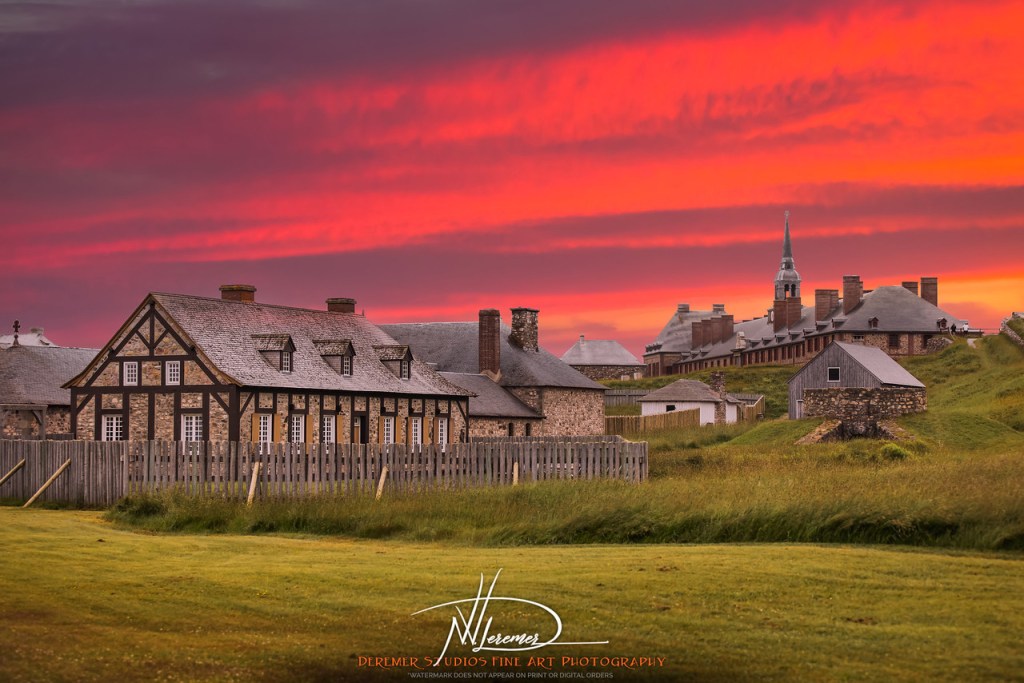
On this Bastille Day, I thought it would be fitting to share a happy little French surprise from our recent trip to Canada. While exploring Cape Breton Island in the province of Nova Scotia, we decided to check out a few National Parks. Fortress of Louisbourg National Historic Site is an amazing reconstruction of the bustling French town toward the middle of the Eighteenth Century.

While Jonathan Edwards and his contemporaries were growing up in colonial New England, the French laid claim to two large islands 600 miles up the rugged coast. Drawn by the immensely profitable and plentiful cod fisheries, the French founded the colony of Île-Royale in 1713, consisting of Cape Breton Island and Prince Edward Island. Unfortunately, the colony was short lived, with the islands ceded to the British Empire just fifty years later, in 1763, as a concession to France’s loss of the Seven Years’ War. Within just a few years, there was little remaining of the bustling city of Louisbourg, as English settlers stripped and dismantled the homes and businesses of the city, using them to build their own abodes.
During the city’s brief fifty-year history, the town grew to a population of over 4,000 people, helping to build one of the largest Atlantic coast settlements of the era, all bankrolled by the lucrative cod industry. Though impressively fortified, the city had its weaknesses, including a sea-focused defense system and vulnerability to assault from the nearby high ground that circled the fortress. Prior to the eventual surrender of the city, it was successfully besieged twice by the British, once in 1748 and again is 1758.

But all was not lost – at least not entirely. 200 years later, in 1964, work begun to reconstruct the city, as it would have stood two centuries earlier. As part of the Canadian Park System, and with detailed research and thousands of man hours of work, the little town once again came to life, beckoning visitors to experience the lives of simple fishermen and provincial governors alike. The scale of the fortress is impressive – with over 50 meticulously reconstructed buildings and structures over sixty acres, all surrounded by an impressive battlement. Needless to say, it was a massive undertaking in modern times, let alone in the colonial era. And what’s especially poignant is that the reconstruction of this little city has now lasted longer than the original settlement itself.
“Come now, you who say, “Today or tomorrow we will go into such and such a town and spend a year there and trade and make a profit” – yet you do not know what tomorrow will bring. What is your life? For you are a mist that appears for a little time and then vanishes. Instead you ought to say, “If the Lord wills, we will live and do this or that.” As it is, you boast in your arrogance. All such boasting is evil.”
James 4:13-16, NASB 1995
As I was reflecting on all the work, time and money that went into constructing this settlement – and so many like it up and down the eastern coast of North America, only for so many of them to fail, I was reminded of a passage in James that reminds us of our proper place in creation. So often, with hubris and a hearty helping of self confidence, we too can set out with grand plans and presumption, investing so much into a future we are certain will happen, only to fall flat on our face. And what do we do when our plans amount to nothing? We become frustrated, angry, and even depressed. We feel we’ve been let down – as if God was our servant, and not vice versa. But this passage makes it clear, God is sovereign and we are not. Presumption is arrogance. It is evil. To make plans as though they are certain to come to pass is to presume upon God’s kindness, and to presume for ourselves a sort of omnipotence and prescience that rightly belongs only to God.

As you scroll through our images and enjoy the picturesque glimpse into a simpler time, remember that the Lord is both sovereign and good. For His saints, God works all things to their good and nothing can thwart His good purposes (Romans 8:28-39). More than that, even our suffering and hardships are not wasted, but are live a surgeon’s scalpel in the Great Physicians hands, producing for us an eternal weight of glory (2 Corinthians 4:16-18). As Christians, we can rest in Christ, making plans for His glory and our joy, but holding to them loosely, knowing that it is His good, gracious and sovereign will that will unfold before us.


Please feel free to pay a visit to our full gallery here.
 The Two Books
Leave a comment