
AND WHY WE LOVE A GOOD REDEMPTION STORY
This past September, I had the opportunity to spend some time in the heart of Detroit while in the area for the Detroit Concours d’Elegance. While in town, Todd, a good friend and colleague (and tour guide extraordinaire) who has called Detroit home nearly all his life, took a few hours out of his busy day to act as the city’s unofficial ambassador. As he promised, downtown Detroit is truly something special – a far cry from the apocryphal byword it has become in the American psyche. In short, today’s Detroit is a surprisingly vibrant, diverse and bustling metropolis that’s worth visiting – made all the more special by its own redemption story!

First settled by a group of enterprising French trappers and furriers in 1701, the abundant waterways and fertile lands along the Detroit River proved an irresistible enticement for French and English settlers alike, transforming the fledgling settlement into a bustling frontier city of over 2,400 by the late eighteenth century. In the nineteenth century, now a part of a rapidly expanding United States, the burgeoning shipbuilding, mining and shipping industries of the region led to profound growth, with the city swelling to over 100,000 residents by 1870. Accompanying the explosive growth of industry, was an influx of substantial wealth and Gilded Age civic and private development that led to the city being nicknamed the Paris of The West.
As the twentieth century dawned, the industries of the previous decades would coalesce in a remarkable way, just in time for the fledgling automotive industry to take firm root on the banks of the Detroit River. Once seen as a superfluous fad for the rich and powerful, thanks to Detroit innovators like Henry Ford and the Dodge Brothers, it took barely a decade for the automobile to take the nation, and indeed the world, by storm, irrevocably transforming the American landscape in the image of the now-ubiquitous automobile. Fueled primarily by this industrial boom, by 1920, Detroit had risen to the fourth largest city in the United States.

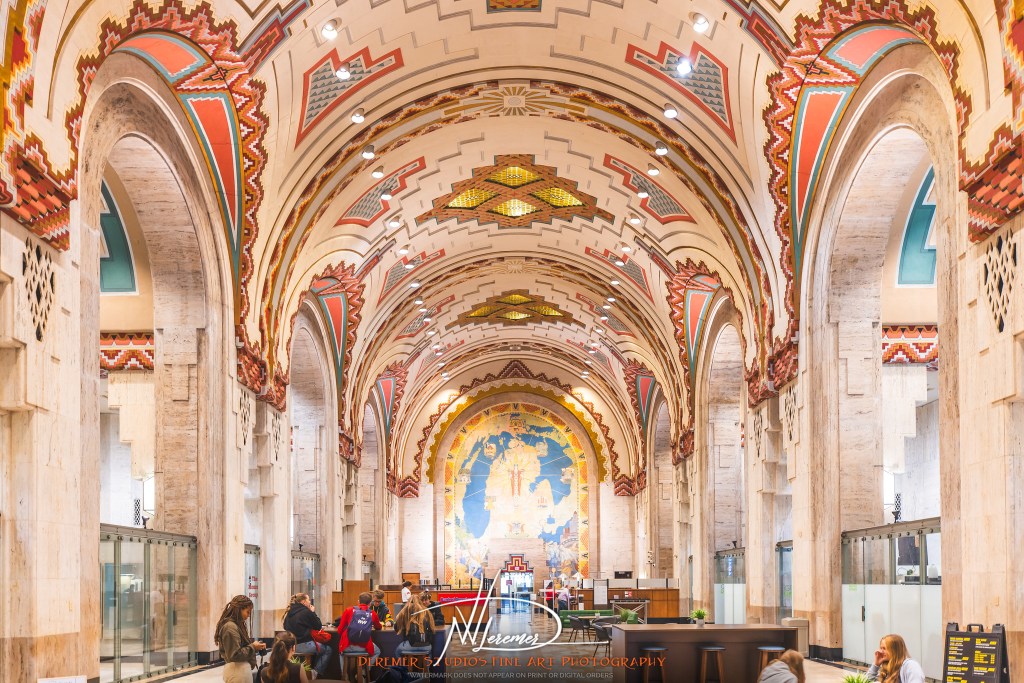
It was in this era of unbridled optimism, jazz music and art deco excesses that so many of the iconic skyscrapers of Detroit sprung from the ground. In 1928, the the thirty-story Fisher Building (above) was opened, an art-deco exterior and shimmering gilded interior shimmering with the Mayan Revival design that was in vogue in the 1920’s. A year later, the the forty-story Guardian Building (below) was opened with a yellow and red brick exterior adorned by stylized Mayan-inspired carvings, vibrant mosaics and an expansive vaulted interior.

Detroit continued to grow throughout the early to mid-twentieth century, peaking at over 1,800,000 people in the 1950 census. But mergers and consolidations in this era would begin to chip away at these gains, alongside a rather ironic side-effect of the automobile – urban sprawl. Indeed, the family car made it possible for the growing ranks of middle class families to flee from the dingy, diverse and cramped city en masse, transplanting their lives to the more desirable suburbs. With this exodus of the middle class, and accompanying it, the relocation of more and more manufacturing away from the center of the city, tax revenue dried up and infrastructure and services began to suffer, inordinately impacting minorities and adding fuel to the smoldering fire of racial tension in the city.
In the early morning hours of July 23, 1967 a police raid on an unlicensed bar sparked five days of riots, arson and violence, leaving 43 dead, over 1,000 wounded, and over 2,000 building damaged or destroyed. In its wake, residents and small businesses left the city in droves, only compounding the inequalities and insufficiencies felt by Detroit’s citizens. By the close of the twentieth century, the city’s population had dwindled to half of it’s high water mark just fifty years earlier. By all accounts, downtown Detroit had become a dangerous, rundown and undesirable place to spend your time – and with an estimated 40% of the city’s lights broken, most didn’t dare to frequent downtown at night.

But thankfully, that’s not how the story ends. The twenty-first century has been a time of restoration and rebirth for The Motor City. With the help of both large-scale infrastructure projects and grassroots renovation groups alike, the city has metamorphosed into a beautiful example – perhaps the best example – of urban renewal in the United States. Among it’s accolades, the city’s riverfront regularly tops the lists of the nation’s best, and provides ample green space, entertainment venues and watersports opportunities along the blue-green waters of the Detroit River. Not unlike the Renaissance Center’s resplendent towers, the city, itself is undergoing its own burgeoning renaissance, block by block and floor by floor, and has once again become a place residents are proud to call home.
The Moral of the Story
A great story right? But why is it that these sort of redemption stories always give us the warm and fuzzies? I’d posit that apart from the human tendency toward sentimentalism, or more rightly, as it proves the point – our hearts long for redemption. We look all around us, and while there is joy and beauty and wonder, there is no avoiding the fact that we live in a desperately broken world. Paint fades, roads develop potholes, our bodies deteriorate, relationships fail, viruses kill, buildings collapse, children die… And while we try, both individually and collectively to make the world a better place, the truth is inescapable; despite all our best efforts, all is not right with this world. Even in our best, most altruistic solutions, they is always a compromise between good results and costly side effects. But we long for so much more – we long for something perfect – for a satisfaction that will not falter or fade!
“For the creation was subjected to futility, not willingly, but because of Him who subjected it, in hope that the creation itself also will be set free from its slavery to corruption into the freedom of the glory of the children of God.”
Romans 8:21-22, NASB 1995
In the passage above, the Apostle Paul makes the point that not just ourselves, but all of creation is longing for a day of full and final restoration. Deep down, we all know all is not right out there, and if we’re honest we’d likely admit all is not right inside ourselves, either. We’re painfully aware of our failings. Our regrets can shine like neon signs during the dark nights of our soul.
But the amazing truth from this passage is that this doesn’t have to be in vain, because the futility we feel within and see without has a purpose! Our brokenness has a point! Our suffering is meant to point us to our only hope! And this isn’t one of those wishful thinking sort of hopes, either, but a certain-sure hope that will not – indeed cannot – disappoint. You see, our brokenness is designed to dissuade us from seeking satisfaction, solace and redemption through ourselves and the good gifts we are given, but rather points us to the all-sufficiency, beauty and wonder of Christ as our only true and lasting hope.
As C.S. Lewis pointed out, all the redemption stories we love are pointing us to the true redemption story. The story’s pretty formulaic – things start out good, something happens to turn things upside down, all looks lost, but just at the right time, the unexpected happens and against all odds, the person is restored, and the good that they started out with is now doubly sweet and precious to them. This is a picture of the greatest story. From Eden to Eternity, this has been God’s redemptive arc!
Our earliest ancestors, Adam and Eve were given everything by God, yet they thought they new better than their loving creator. They turned away from God and we’ve been doing the same ever since. As the Old Testament unfolds, we see God’s initiating love again and again and again, yet His people choose their own way. They try judges and kings and prophets and priests, but all their attempts fall woefully short. And so, the Old Testament closes with failure and 400 years of silence, yet even still, its pages ring with the refrain of a hope to come. But this hope would come in the most unlikely form, Jesus, God Himself, incarnated as a human child in His mother’s womb. Some thirty years later, after living a sinless life of service, love, sacrifice and proclamation, Jesus willfully and intentionally went to the cross to pay the cost for our sins that we never could, not in a billion years. There, under God’s holy wrath and just condemnation, the just paying the price for the unjust, Jesus died.
And if that was the end of the story, Christians are among all, the most to be pitied (1 Corinthians 15:19). But, praise God that was not the case. In three days, God raised Jesus from the dead, proclaiming Christ’s victory over the grave for all who would believe. And so the invitation stands. God calls us to turn from our sin and self-reliance, and to find our only joy, hope and boast in the cross of Jesus Christ – to find Him to be our greatest treasure and all-satisfying joy in this life, and for endless days to come. it is this glorious truth – the truest truth – that doesn’t just bring us to faith, but sustains it every step of the way!
“And you were dead in your trespasses and sins, in which you formerly walked according to the course of this world, according to the prince of the power of the air, of the spirit that is now working in the sons of disobedience. Among them we too all formerly lived in the lusts of our flesh, indulging the desires of the flesh and of the mind, and were by nature children of wrath, even as the rest. But God, being rich in mercy, because of His great love with which He loved us, even when we were dead in our transgressions, made us alive together with Christ (by grace you have been saved), and raised us up with Him, and seated us with Him in the heavenly places in Christ Jesus, so that in the ages to come He might show the surpassing riches of His grace in kindness toward us in Christ Jesus. For by grace you have been saved through faith; and that not of yourselves, it is the gift of God; not as a result of works, so that no one may boast.”
Ephesians 2:1-9, NASB 1995


Want to see more? Please feel free to pay a visit to our full gallery here.
 The Two Books
Leave a comment