An Ask Pastor John Highlighting the Beauty of the Two Books of God’s Revelation to Mankind
Pastor John Piper’s long-running APJ (Ask Pastor John) podcast recently touched on something near and dear to the heart and ethos of this blog, and I thought it fitting to share. In APJ 1999, Pastor John shines a light on Proverbs 6:6f and how this example illustrates how the principles that make for sound Biblical interpretation, as expounded upon in his 2010 book, Think, are the same principles that make for sound interpretation of everything we encounter in the created world, as he explores in his latest book, Foundations for Lifelong Learning: Education in Serious Joy.
In the podcast, Piper points to the Belgic Confession (1559, 1618,19) as one of the clearest early discussions of the two books of God’s revelation to mankind; Creation and God’s Holy Word. Article 2 of the confession, in particular, makes this exposition explicit, pointing to the first book (in order, not necessarily importance) being “the creation, preservation, and government of the universe;1 which is before our eyes as a most elegant book…” and the second book being God’s “holy and divine Word” by which “He makes Himself more clearly and fully known to us.” Among the passages it points to for these assertions are Psalm 19:2, 8, Ephesians 4:6, and 1 Corinthians 12:6, but Piper points to Proverbs 6:6f as divinely-inspired example by which both books work harmoniously together to instruct us:
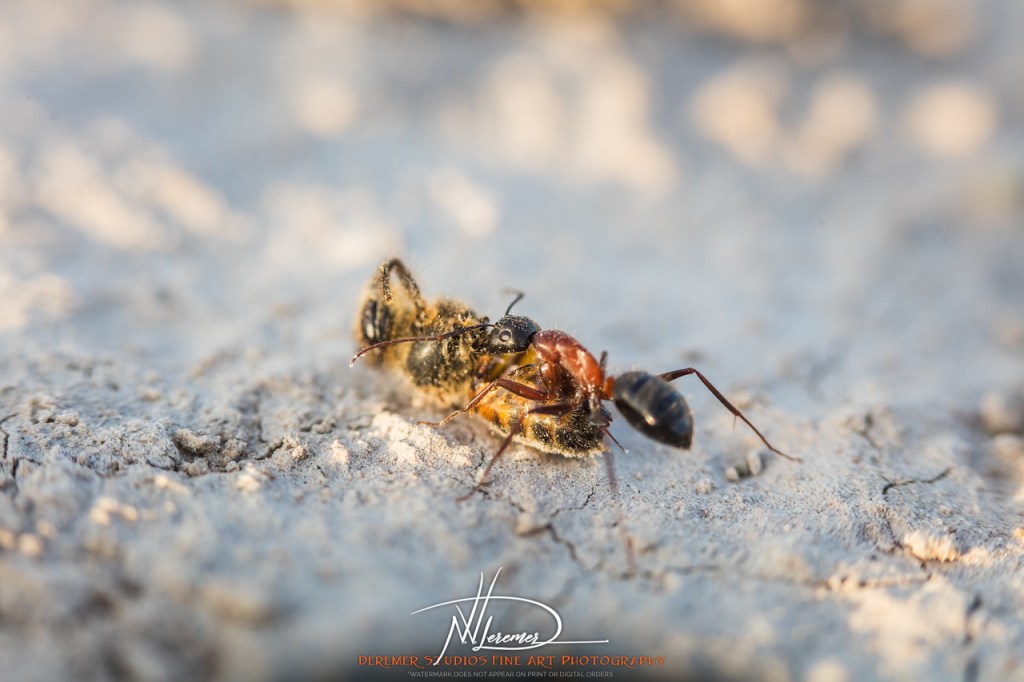
“Go to the ant, O sluggard, Observe her ways and be wise,
Proverbs 6:6-11, NASB 1995
which, having no chief, officer or ruler, prepares her food in the summer and gathers her provision in the harvest. How long will you lie down, O sluggard? When will you arise from your sleep? “A little sleep, a little slumber, a little folding of the hands to rest” – Your poverty will come in like a vagabond And your need like an armed man.”
This passage offers a remarkable example of how even seemingly mundane aspects of God’s creation can help us to understand and apply important precepts of God’s Word. Though the ant is small, it is mighty. Depending upon the species, the humble ant can lift between ten and fifty times its body weight. On the upper end, that’s equivalent to an average human deadlifting a Hummer EV…with their mouth. But that’s not the only thing that’s noteworthy about this diminutive creature. As this passage points out, God has implanted an instinct within them to gather, hour by hour, day by day, to provide for the needs of themselves and their colony. Individually and as groups, they gather during the warm months, traveling the human equivalent of over 100 miles a day, that they might thrive during the cold winter months in relative warmth and plenty.
This is not the way of the sluggard. Disney’s 1934 Silly Symphony (and a favorite of mine as a youngster growing up with the Disney Channel), The Grasshopper and the Ants paints this dichotomy well. The fanciful morality tale opens with a fiddlying, frolicking grasshopper, contrasted with a colony of ants meticulously harvesting the remains of a summer’s picnic. The grasshopper represents the sluggard, sitting on his pitard, lecturing the ants about God’s provision as an excuse to not work – repeating his diddy, “The world owes me a living” as he distracts a young worker ant from his duties. But soon, winter comes, and with no food or shelter prepared, the desperate grasshopper collapses in the snow, echoing the warning of Proverbs 6, “Your poverty will come in like a vagabond And your need like an armed man.” Yet, perhaps meant as a picture of God’s undeserved grace, the ants rescue the now frozen grasshopper and nurse him back to health. And indeed, the grasshopper changes his tune to, “I owe the world a living”.
And while the conclusion could easily be taken to be more moralistic that Gospel-centered, nonetheless, the lesson of the ant is clear – to be a sluggard is to presume upon the goodness and kindness of God and such a course of action is unlikely to end well. The ant – this tiny little part of creation is meant to point us to wonderful Biblical truths if we have eyes to see it. We see this example again and again in Jesus’ teachings, where we’re told to consider the lilies (Luke 12:27), to think of leaven (Matthew 12:33) or to contemplate the mustard seed (Matthew 13:31). Creation is a powerful teacher and tool for the saint, and can provide a panoply of winsome similes to share the beautiful truths of the Gospel with a world desperately in need.
So, as we go about our day, might we be like the majestic eagle, looking out over the world with a sharp eye, tuned by the Spirit to see the glorious details of the wide world around us, and the stunning realites it proclaims about the worth and wonder of our God!
 The Two Books
Leave a comment