
The 4 Chapters
Bobs, Buddies, and Goodest Boys (Part 1)
By Contributing Author, Robert Shashy
Based on recent data, Thanksgiving is the most popular holiday in the United States. An estimated 80 million people will travel at least 50 miles between the Tuesday before Thanksgiving and the Monday that follows. Over 250 million dollars will be spent on food and beverages for Thanksgiving. Typically, 44 million people watch the Macy’s Thanksgiving Day parade, and over 34 million people on average watched the slate of NFL games held in 2023. In fact, when I asked the man working in the deli at my local grocery store this week if he had any plans for Thanksgiving, he told me that he was just going to his daughter’s house. He then followed his lukewarm statement with a much more excited “at least we have football.”
Thanksgiving represents a lot to a lot of people. Between actually being thankful, spending time with family, enjoying “good food,” the tasks of travel, navigating family drama, and rooting for your team to win, a cornucopia of work and emotion go into making Thanksgiving live up to its status as the start of the holidays. And it should, probably. I remember a professor from my time at Florida State University who said Thanksgiving was his favorite holiday, because it was divorced from politics and religion. It was simply a day to be thankful, and enjoy your blessings with the people you loved. That was the first time I had considered that Thanksgiving could be anybody’s favorite holiday. That take still seems as bland to me as a bowl of cold, butterless mashed potatoes.
Halloween stands out because it connects us with our most primal selves, and pushes us to seek the divine to escape the demonic. Christmas, for all the silly secular magic that has been mixed into the season, still is a reminder that the Holy God of the universe put on the imperfect flesh and lived a perfect life out of love for His people. Easter reminds us even more of the full extent of God’s love. Even St. Patrick’s Day, Martin Luther King Jr. Day and Independence Day deeply reminds us about the specifics of a group of people (or at least they should). When I think back to my former professor’s proclamation of his love for Thanksgiving, I remember being surprised, because I really, really dread Thanksgiving Day.
Bob’s Burgers Turkeys
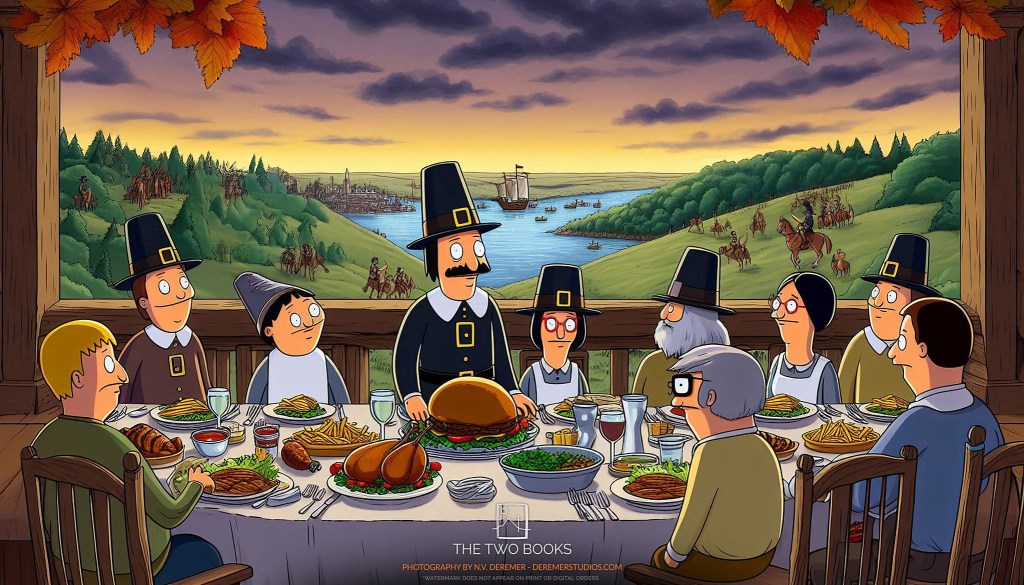
Something I do love, or like a lot, is the Fox animated comedy Bob’s Burgers. Debuting while I was at FSU, I’ve been a long-time fan of the show. The show focuses on Bob Belcher, a burger restaurant owner in a town by a wharf, his wife and children, and the challenges they face to keep their business open. The show is currently airing its fifteenth season, and from seasons 3-13 there were dedicated episodes for the end of year holidays: Halloween, Thanksgiving, and Christmas. For the past few years, I watch through those episodes as each holiday approaches. And wouldn’t you know for as much as this real-life Bob doesn’t like Thanksgiving, it’s the animated Bob’s favorite holiday.
Bob’s love for Thanksgiving is established in the season 3 episode “An Indecent Thanksgiving Proposal.” Despite the potential five months of free rent his family would receive, Bob cannot watch his wife and children be his landlord’s family, all while he is stuck alone in the kitchen. As the episode unfolds, and Bob’s love leads him to nearly be shot, his family realizes that Bob means more than free rent. The importance of family, especially during the holidays is a consistent theme of the Thanksgiving Day episodes. In “Turkey in a Can” (Season 4), Bob is trying a new process to prepping his turkey, but someone keeps putting it in the toilet. Eventually, Bob’s wife Linda realizes that he is sleep walking and dreaming of how he potty trained his children. Bob’s problems stem from his love for his family. In “Dawn of the Peck” (Season 5), Bob has to be rescued from a horde of aggressive turkeys when he goes to the store last minute to prepare Thanksgiving dinner. Season 6 finds Bob pulling his sister-in-law to his house in a kiddy pool, and in season 9 Bob helps keep a turkey from being sent to a slaughterhouse because he doesn’t want his children to grow up thinking adults lie. In season 10 Bob realizes that his special turkey isn’t worth ruining his daughter Tina’s scouting project, and I could go on.
The writers understand that Thanksgiving isn’t everyone’s favorite holiday though. In the season 8 episode “Thanks-hording” Ted, Bob’s best friend and best customer, has to prepare Thanksgiving dinner for his sister, her husband, his mother and her new boyfriend. Ted calls on Bob to cook for him, but instead he has to face his hoarding tendencies when Linda wants to throw away lots of broken household items he has lying around. Being a handyman, Ted insists can fix them eventually. By the end of the episode Linda realizes Ted doesn’t associate Thanksgiving with the same emotions Bob does, but with the difficulties of his parents’ marriage. The season 12 episode follows a similar arc. Bob is roped into cooking Thanksgiving dinner for an elder folk’s home, and when his younger daughter Loise is stuck helping him cook, they begin arguing. She eventually walks out when Bob becomes a “Thanks-zilla.” Eventually Bob realizes he can be too controlling in the kitchen, and Loise comes back to help him finish prepping the meal.
Of course I’ve simplified the plot of these episodes, but there are consistent themes here. And some of these themes, such as the value of family and forgiveness are common ground between the society and Scripture. As Christians, we should always be looking for opportunities to show the culture how they ultimately are looking for Christ, just as Paul does in Acts 17. But Bob’s Burgers isn’t the only animated show that has expressed the sentiments discussed above.
“16 Now while Paul was waiting for them at Athens, his spirit was provoked within him as he saw that the city was full of idols. 17 So he reasoned in the synagogue with the Jews and the devout persons, and in the marketplace every day with those who happened to be there…22 So Paul, standing in the midst of the Areopagus, said: “Men of Athens, I perceive that in every way you are very religious. 23 For as I passed along and observed the objects of your worship, I found also an altar with this inscription: ‘To the unknown god.’ What therefore you worship as unknown, this I proclaim to you.”
Acts 17:16-17, 22-23, NASB1995
Predating Bob on Fox was Hank Hill in King of the Hill. Hank also is a fan of Thanksgiving. That makes sense though, as series creator Mike Judge intended Hank Hill, and every other character in the show, to reflect real life people in America. So, the same tensions surrounding Thanksgiving are present. In the season 4 episode “Happy Hank’s Giving”, The Hill family is trying to navigate air travel to visit Hank’s in-laws in Montana. However, poor weather conditions cause a series of delays, and, ultimately, Hank decides it’s better to help another family make their flight at the cost of the Hill’s trip. The episode has a subplot where Hank’s neighbor Bill has no family to share Thanksgiving with, so Bill makes up a fake uncle so he can drive the Hill family from Arlen (the fictional setting of the show located somewhere near Houston) to Dallas for their flight. While brief, the show hints at how lonely Thanksgiving can be for some. Yet, like with the Belchers, the Hills and their friends eventually overcome their Thanksgiving misfortune through togetherness. These themes aren’t just a part of Fox’s animated lineup in the 21st century though, but can be traced back to 20th century cinema.
The Annual Migration
While I have been re-watching Bob’s Burgers for the last few years, with minimal exception, I’ve been watching the movie Planes, Trains and Automobiles (PT&A) annually before Thanksgiving since I was a kid. As a side note, if you just look at the IMDB information for the movie, you might find it odd that my parents let me watch an R Rated movie as a kid, but PT&A really shouldn’t be an R Rated movie. Generally speaking, outside of one scene, the movie is in the nebulous 80’s movie rating area between PG and PG 13.
Editor’s note: As a word of cautionary elaboration, this movie’s R rating is primarily due to one expletive-laced tirade. However, there are also substantial inappropriate uses of “god”, some sexual conversation, brief sexual imagery and period-accurate tobacco and alcohol abuse that may warrant further investigation before viewing. IMDB provides a helpful crowd-sourced parents guide which thoroughly outlines these concerns. For additional reading on the subject of honoring God best in our entertainment, consider our recent article on the subject, below.

BUT IS IT BEST: ENTERTAINMENT
Be careful little eyes, what you see… How can Christians navigate the world of entertainment overload in a way that best honors God and guards, equips and uplifts us and the people we love?

That said, much like with the Belchers and Hills, the story of Neal Page (played by Steve Martin) and Del Griffith (played by the late John Candy) traveling from New York to Chicago has many of the same themes and underpinnings. As the title suggests, Planes, Trains and Automobiles finds businessman Neal Page and salesman Del Griffith traveling from New York City to Chicago the Tuesday before Thanksgiving. However, much like with the Hill family, above, their flight is delayed, then detoured by bad weather. As the movie continues Neal and Del, who meet when Del inadvertently steals Neal’s cab in NYC, are forced to help each other get home in the vein of other reluctant “buddy comedies” such as Tommy Boy or perhaps Turner & Hooch.
One of the early tone setting probs in PT&A is Del’s trunk. Neal trips over it while trying to race a young Kevin Bacon to a taxi in one of the early scenes. A while later, after Neal and Del’s flight has been rerouted to St. Louis, they attempt to travel by train. And as the title suggests, the train has engine issues, requiring them to later travel via a variety of automobiles. As Neal is getting off the train, and being told to walk across a field, he sees Del struggling to pull his trunk through the field. In a previous scene, Neal was clearly ready to begin traveling on his own, but seeing Del needs help, he chooses to lift one end of the trunk as the two carry it together. A few scenes later, Neal will again reiterate his sentiment that he is better traveling alone, and Del’s character—clearly hurt emotionally—walks off believing he will not see Neal again.
However, after much frustration for Neal in the aforementioned fowl language laced scene, Del is reunited with Neal after Del almost runs over Neal at a car rental. The following scenes detail how Del accidentally starts driving the wrong way on the highway, nearly drives them into a pair of semi-trucks, and then accidentally sets the car on fire. At this point, Neal is furious with Del, and is ready to leave Del in the cold at their motel when Del cannot afford a room. As Del starts talking to himself as if his wife is present, he recognizes that he may have ruined another opportunity at friendship. Ultimately, though, Neal invites Del to stay in his room, and the two spend the night raiding the mini bar, and relishing in the fact that they at least have their wives to grow old with. If you’ve seen the movie, you know how the film concludes, if not, here is your spoiler warning for a 37-year-old film (skip ahead to the next section of the article below).
As the movie comes to a close, Neal and Del finally get to Chicago via riding together in the refrigerated section of an 18-wheeler. Then, at the Chicago metro train station Neal and Del say their farewells. With all the time they’ve spent together, Neal begins to think back over the past 3 days (it is roughly mid-day on Thanksgiving at this point in the movie). As he thinks back over what Del has shared about himself, he makes a stark realization about Del, and returns to the station. There he finds Del sitting alone. When asked why he hasn’t gone home, Del explains he has no home to go to, and that his wife has been dead for 8 years. The film concludes with the scene of Neal and Del carrying Del’s trunk up to Neal’s home, and Neal introduces his family to Del. As Neal is finally reunited with his wife, he says to her “I would like you to meet a friend of mine,” she replies “hello Mr. Griffith,” Del replies “hello Mrs. Page” as if the two have known each other for years, and after a few more smiles, the credits role to the tune of “Every Time You Go Away.”
As I’ve grown older, that final scene has resonated more with me. I’ll admit my eyes are often filled with tears by the time Neal’s wife greets Del into her home. I know both that the Christmas “season” is only a couple weeks away, but I also know I’m done with everything I like about Thanksgiving.
A Man’s Best Friend
When I originally got the idea for this article, I wanted to focus on how I always want to watch the National Dog Show on Thanksgiving Day, but never seem to be able to do so. Since at least my early 20’s, I have said I rather call Thanksgiving “National Dog Day,” and watch the dog show with my own pets. This isn’t because I’m an ungrateful scrooge or humbug, but because where others—like my former professor—have many happy memories associated with Thanksgiving, I have many difficult ones. I am the only son of parents who divorced when I was very young, but shared custody throughout my childhood. I grew up being loved, was raised well, and have many happy memories of the earlier years of life. But when it comes to holidays, especially Thanksgiving, I struggle to remember being happy. Whether it was greeting extended family I didn’t care for only to be yelled at, or hearing family members complain about other family members because I was too full for a second or third Thanksgiving Day meal, or simply being too tired or introverted to be teased by older cousins, I don’t associate Thanksgiving with the blessings I have in the LORD. And I’ve never, ever gotten to watch the dog show from start to finish.
But through Bob’s Burgers, King of the Hill and Planes, Trains, and Automobiles both the big and little screen remind us that while Thanksgiving is a time for family, food and forgiveness, it also has its trying moments. Like Bob and Hank, all of us know a Ted or Bill, or maybe we are that person. With 63 percent of Americans saying that Thanksgiving and Christmas cause at least some challenges to their mental health, and 25 percent of American households now holding a single occupant, a lot of Americans find Thanksgiving to be a lonely time.
There is more of a need for Christians to be the Neal to the Del in their lives. Neal Page did not like Del Griffith originally. Del cost Neal a lot of time, money and frustration. Yet, without Del’s help, its unclear how much harder it would have been for Neal to get home, if he would have gotten home at all. And while the final scene of PT&A holds specific significance to me, it also shares a broader reality: as we live life with others, they become family. While not depicted much on screen, it is clear that Neal’s wife knew Del’s last name, because Neal had been talking about Del whenever he called home. It’s not hard to imagine that Neal shared not only how Del risked their lives, but also the quality of salesman that he was, how genuine he was, and how dedicated to Neal he was in his own way. America has become a place where the nuclear family is held sacred to the exclusion of our neighbors and friends. For as bound together as we are by DNA, the Bible makes it clear that there is blood that unites us into an even better family.
Making Room At The Table
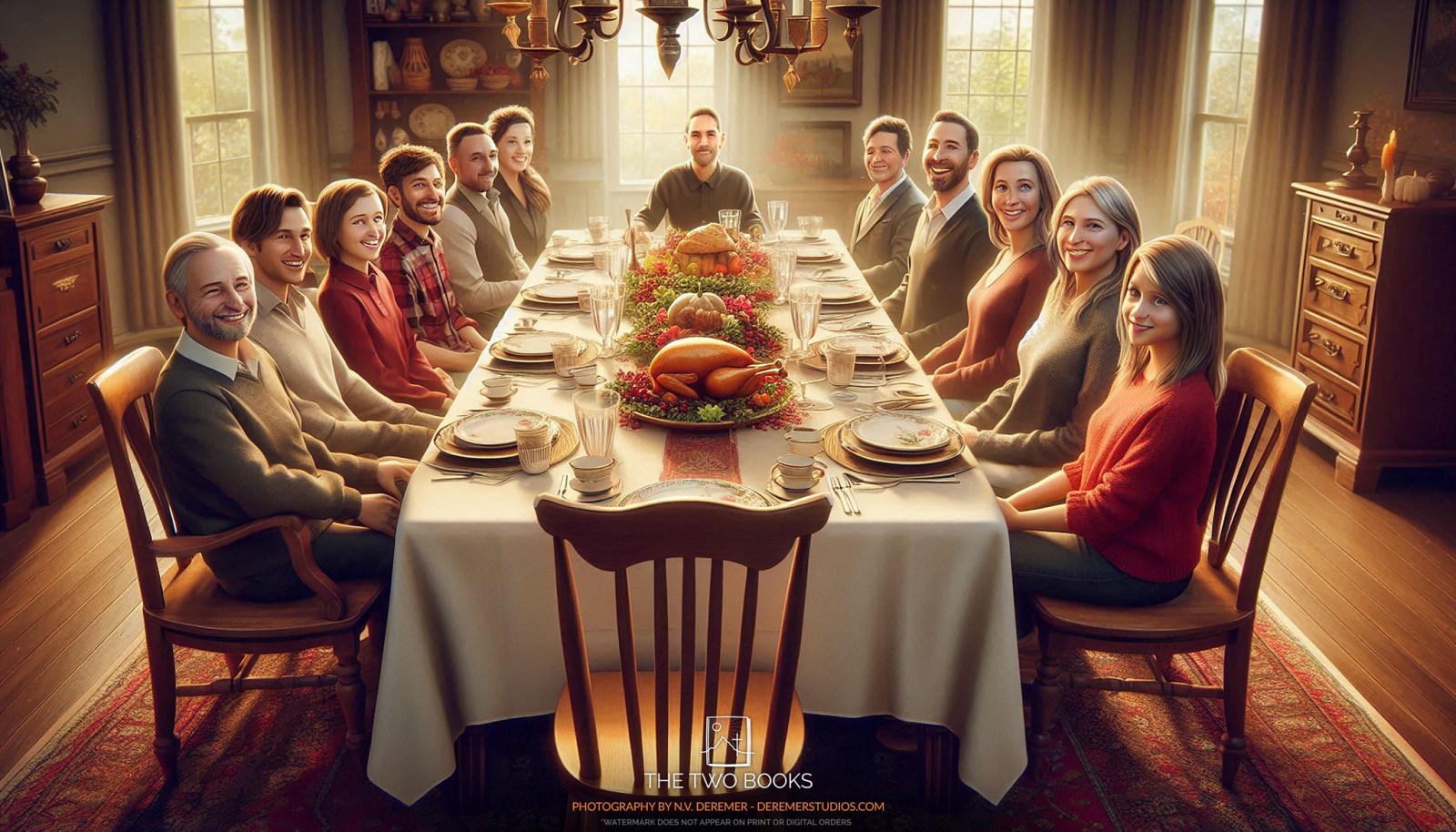
I love my dogs, and Bible passages such as Jonah 4:10-11, Matt. 6:25-34 and Luke 12:22-32 make it clear that God loves and cares for the animals in His creation. As Genesis 2:18-24 details, God made the animals to be man’s companions, but the best companion for man (or woman) is not a dog or a cat. I originally intended to talk through the theology of loving our pets without treating them like people. But the honest truth is that the data suggests we in the Church need to first learn to make room for the Teds, Bills and Del’s in our lives.
“8 Above all, keep loving one another earnestly, since love covers a multitude of sins. 9 Show hospitality to one another without grumbling. 10 As each has received a gift, use it to serve one another, as good stewards of God’s varied grace: 11 whoever speaks, as one who speaks oracles of God; whoever serves, as one who serves by the strength that God supplies—in order that in everything God may be glorified through Jesus Christ. To him belong glory and dominion forever and ever. Amen.”
1 Peter 4:8-11, NASB1995
In their recent book “The Great Dechurching”, authors Jim Davis and Michael Graham detail how the American Church has increasingly been losing members throughout the first quarter of the 21st Century. The book details how socio-political trends have led society away from Christian values, the book provides profiles of the types of people leaving the Church, and the book provides some insight on how to make a path forward for the Church to grow again. I strongly encourage reading the book, it made a major impact on me when I read it earlier this year, and I’m sure it would be insightful for you as well. But the biggest insight that I want to pull from the book as it relates to this article is this: studies find that in the United States people who go to college, start a meaningful career, and then marry and have children tend to benefit the most from how society is set up (taxes, health insurance, etc.) If you get off track with those milestones, it is very hard to course correct. As Davis and Graham point out, in many ways the Church has begun to mirror society, and not the other way around.
Genesis 17 details the covenant between God and Abraham where God promises to make Abraham into a nation. Exodus 19: 5-6 and 1 Peter 2:9-10 describe God ratifying Israel and the Church as His people. Romans 8:12 -17, Ephesians 2: 4-10, and 1 Cor 3:18-23 all detail how the Church is God’s family. But are we making sure everyone who belongs to Christ has a seat at the table? This Thanksgiving, consider the Christians you know who may be struggling through the day. Remember that the only firm foundation is not paved with the blood of your forefathers, but with the blood of Christ (Matt. 7:24-29). Enjoy your earthly family, they are a blessing from the LORD (Psalm 127), but don’t forget those who haven’t received those same blessings. One day Christ will return for His people (1 Thess. 4:13-18), and there will be a greater celebration than the best Thanksgiving Day meal (Rev. 16:7-19). As we enter another holiday season, and continue to wait for the return of Christ, don’t forget those who call upon Christ but are single, are lonely, or are marginalized in some way. Glorify God by making room at the table, that all God’s people can taste and see that the LORD is good. Happy Thanksgiving.
About the Author
Robert Shashy was born and raised in Jacksonville, Florida. He attended Catholic school from kindergarten through the 12th grade, and was devoted to weekly church attendance. While at the University of Florida, he began attending Reformed University Fellowship (RUF) meetings, and deepened his relationship with Christ. He remains compassionate towards practicing Roman Catholics, and believes Reformed Catholicity is key to both the American and global Church. He currently is attending Reformed Theological Seminary (RTSO) as a hybrid student, and is an aspiring church leader. Robert feels called by Christ to contextualize American culture to help the Church in sharing the Gospel in the 21st Century, and to inform modern Christians of who the Bible says they are, what society says about them, and how to follow Christ’s lead in those crosswinds. In his free time, Robert is a hobby board game enthusiast, and he looks forward to the day when the Church again embraces her roles of being a safehouse and a hospital.
 The Two Books
Leave a comment