
A Winter Wonderland Atop Virginia’s White Top Mountain Stirs Christmas Reflections of Jesus – the One Born to Make us Whiter than Snow.
“7 Purify me with hyssop, and I shall be clean; Wash me, and I shall be whiter than snow. 8 Make me to hear joy and gladness, Let the bones which You have broken rejoice. 9 Hide Your face from my sins And blot out all my iniquities.”
Psalm 51:7-8, NASB1995
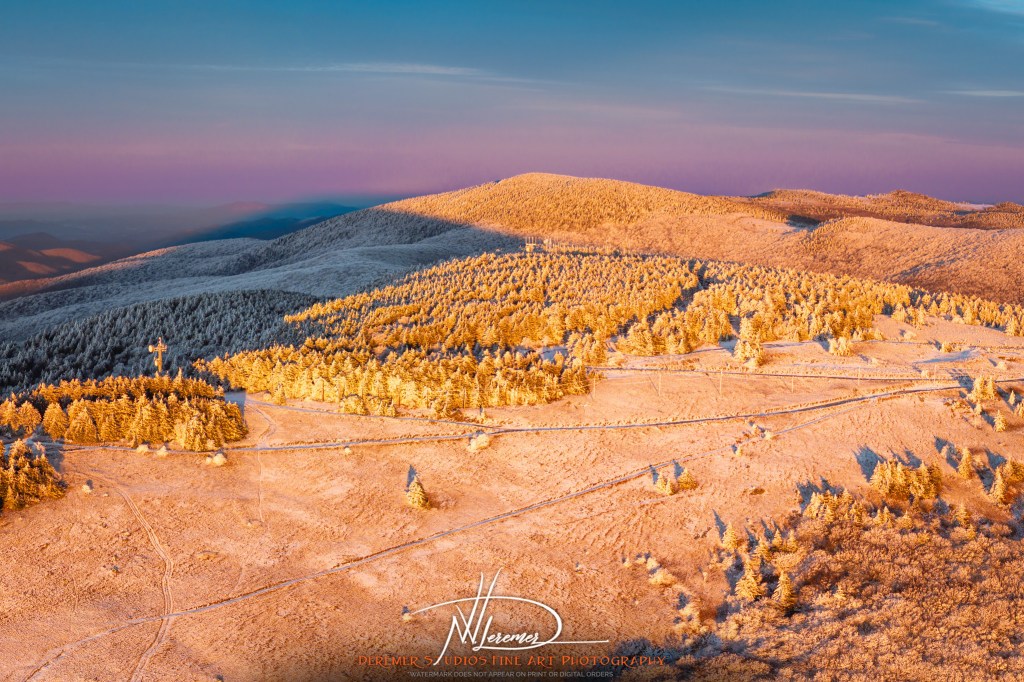
On the eve of the Winter Solstice, an icy, sticky winter storm blew through southwestern Virginia, covering the hills and valleys in a combination of ice and snow, and crowning the higher elevations with a resplendent combination of ice, wet snow and powder that covered nearly every boulder, bush and tree. As has become my tradition whenever I visit Abingdon, I took to the roads and headed toward one of my favorite places – White Top Mountain. At 5,520 feet, it’s the second tallest mountain in Virginia (second only to Mt. Rogers), and the tallest mountain you can summit by car. With a climate and biome more like southern Canada, it’s home to a unique, naturally occurring highland meadow along the mountain’s ridge. As long as the mountain isn’t socked in by clouds (which it can often be), the summit provides beautiful vistas any time of the year. Yet in all my many years of visiting this special place, this was the first time I’d been able to summit the mountain while it’s been dressed in all its winter glory. And I had the great pleasure of doing it not once, but twice in just over 24 hours.
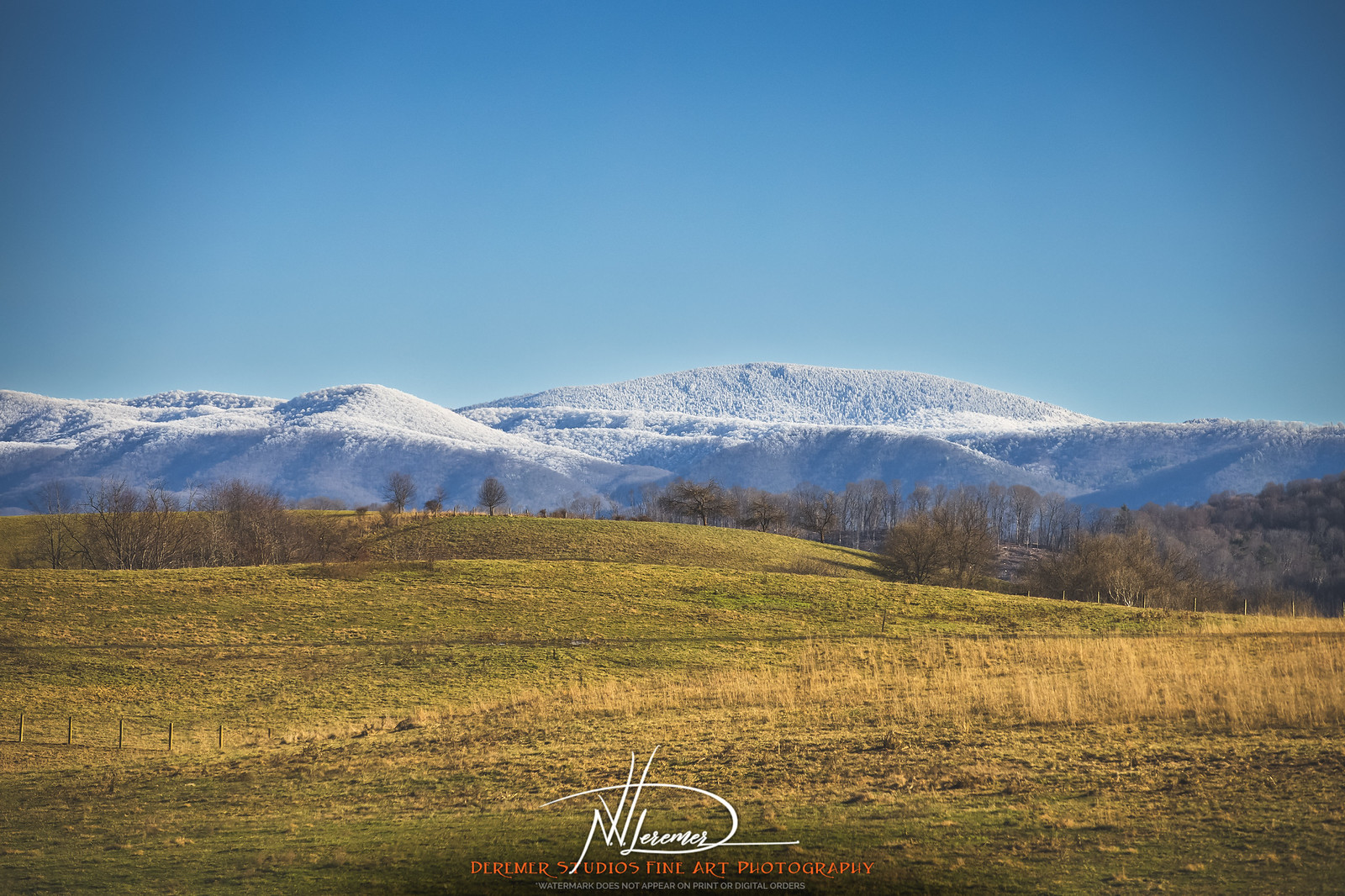
Though I’ve been unable to find out exactly how White Top first got its name, looking out toward the summit from the valleys near Glade Springs on days such as the one above (taken two days after the storm, when the snow in the lower elevations had already melted), seems to hint at an answer. Not only do the whitewashed trees along the mountain’s upper elevations shine white against the greens and browns of the hills and dales below, but the highland meadow, with it’s snow-encrusted low grasses and alpine shrubs, shimmers doubly bright in the afternoon sun.
But, nomenclature aside, the morning after the storm, with lingering low-hanging clouds blocking the melting rays of the sun, almost all the trees (and everything else) were lined with a delicate, crystalline coating of ice and hardened snow. Neither words nor photos do the experience justice, but I hope these images give you a taste of the beauty and grandeur of my moments spent along the slopes and meadows of White Top’s winter wonderland.
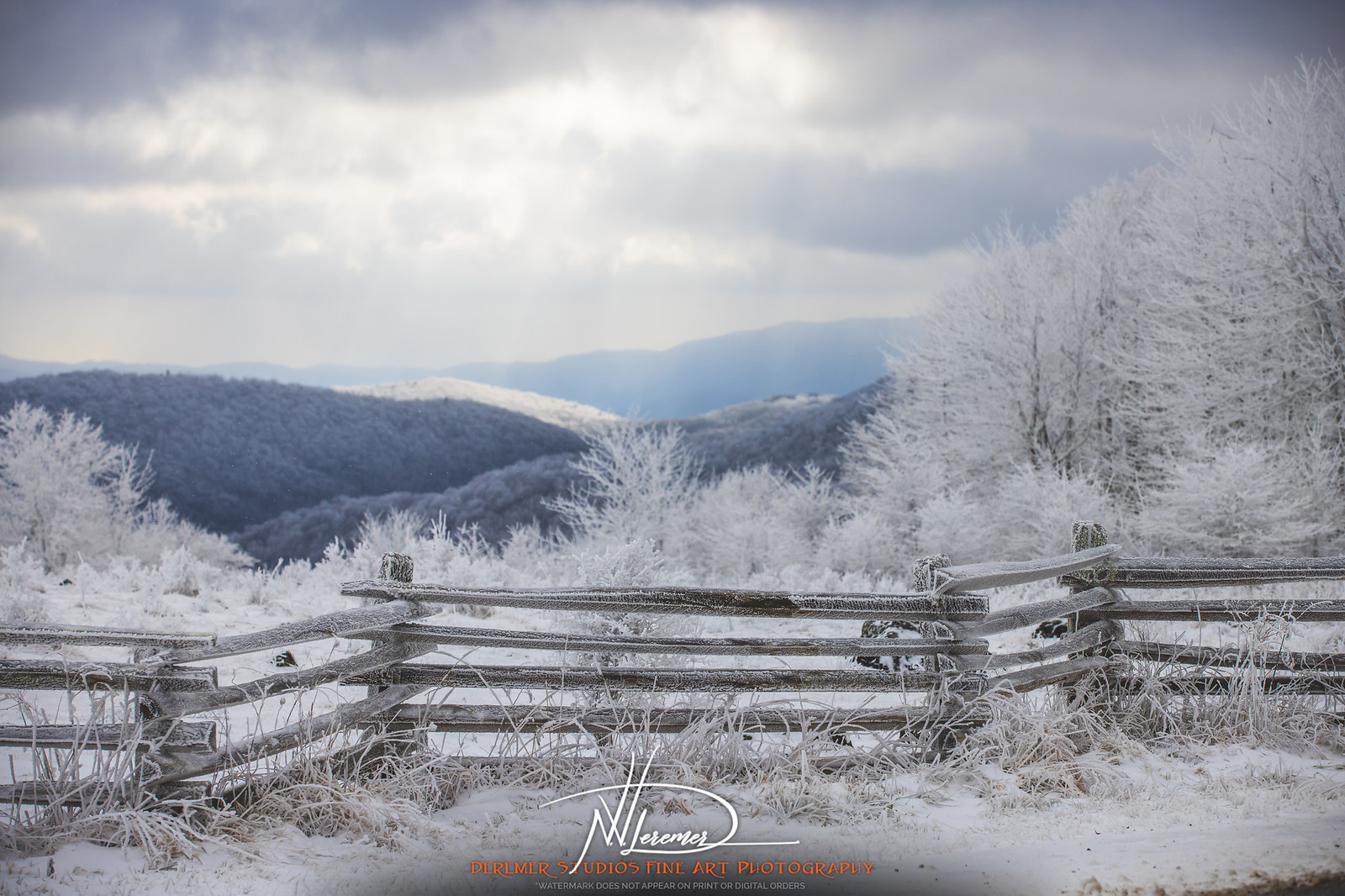
One thing that struck me was the fleeting nature of this beauty. Being so far south, it doesn’t take long for the sun’s radiating power to transform the whitewashed hills and valleys back into the dappled browns and muted greens of the Virginia winter. Hour by hour and foot by foot, like a giant scything eraser, the white dusting was wiped away on higher and higher elevations. Within 24 hours, there was scarce any snow below 4,000 feet, and within 48 hours, all but the slightest hint of white on White Top’s highest meadows had disappeared.
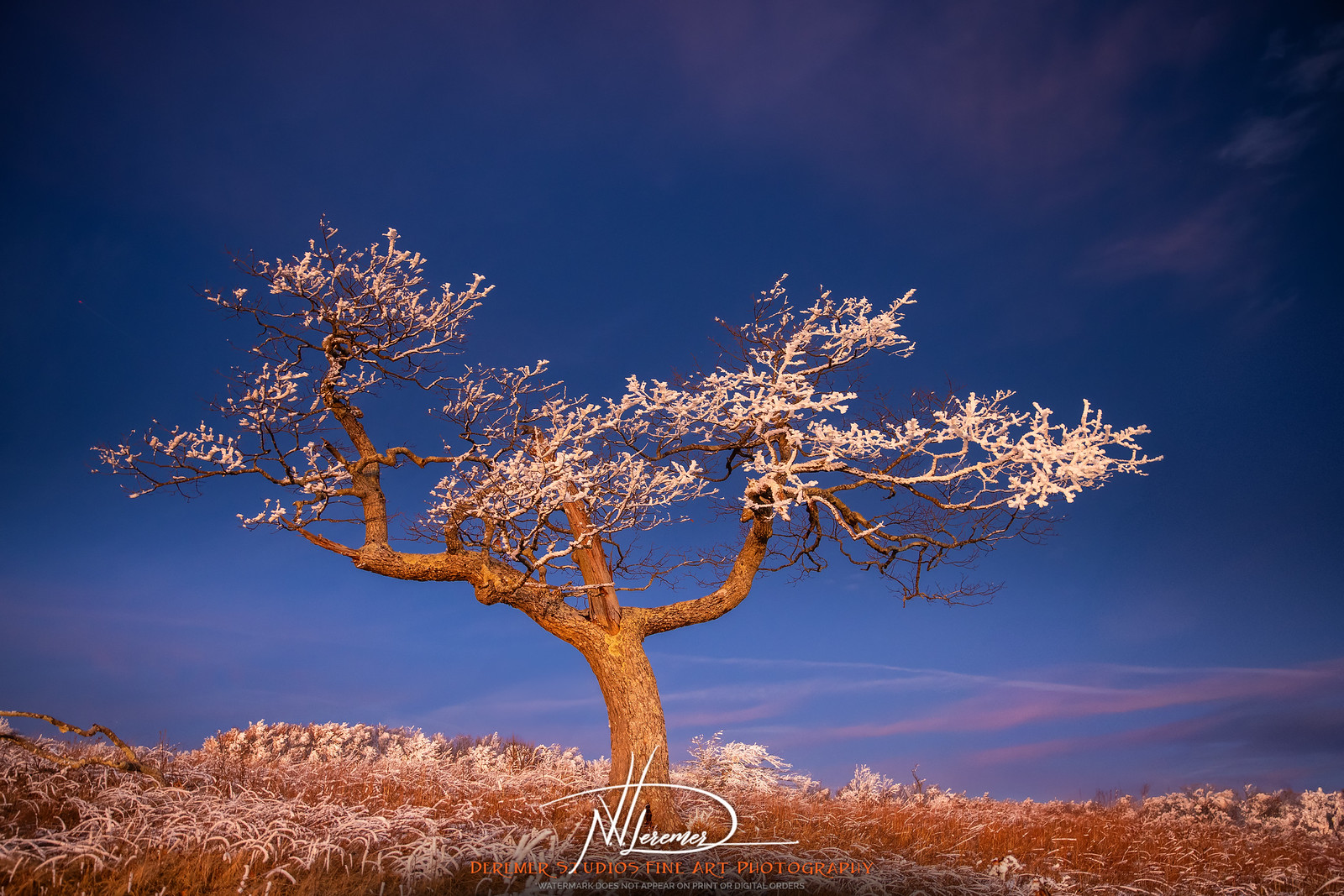
Thankfully, when we again ventured up the winding, snow-covered three-mile dirt road – now more icy and slick, presenting a bit more of a challenge for our 2WD minivan with summer tires – we found that the majority of the summit’s snow was still very much intact. Arriving in the late afternoon, some 30 hours after the last flakes had fallen, we decided to stick around for sunset. Boy was it worth it! Minute by minute, as the sun sunk below the horizon, the scene changed, casting yellow, then orange, then purple pastel hues on the snow-covered summit. One tree, in particular, though full-sized, appeared like a bonsai tree with it’s coat of white snow lingering upon its outer branches.
Washed Whiter Than Snow
“18 Come now, and let us reason together,” Says the Lord, “Though your sins are as scarlet, They will be as white as snow; Though they are red like crimson, They will be like wool.”
Isaiah 1:18, NASB1995
When we arrived up at White Top on that second day, I couldn’t help but think of David’s words in Psalm 51. The bright white of the mountaintop, contrasting with the deep browns and elongating shadows on the hills and hollers below, reminded me of the darkness of my sin and the way it fights so hard for dominance of my soul. How many of us, along with Paul (Romans 7), can lament the corruption that still remains – that old man marching up against the mountain of our soul, seeming to gain ground like the climbing darkness of the thawing snow upon the mountain sides?
Psalm 51 is a poignant psalm – a psalm of repentance and hope amidst the backdrop of pitch-black sin in David’s life. After taking a woman who was not his – perhaps against her will – and then having her husband murdered to cover up his initial sin, and having gone on for months without repentance, even still, God moved toward David to produce the fruit of repentance through the prophet Nathan. What David deserved was death. If I were Uriah’s mother or Bathsheba’s father, I would have no doubt been eager to see God’s righteous justice upheld – to see David receive the just consequences of his offense. And yet the Lord moved toward David in mercy.
“23 for all have sinned and fall short of the glory of God, 24 being justified as a gift by His grace through the redemption which is in Christ Jesus; 25 whom God displayed publicly as a propitiation in His blood through faith. This was to demonstrate His righteousness, because in the forbearance of God He passed over the sins previously committed; 26 for the demonstration, I say, of His righteousness at the present time, so that He would be just and the justifier of the one who has faith in Jesus.”
Romans 3:23-25, NASB1995
This is, as many have noted, a scandal of grace. Taken at face value, such an overlooking of justice is tabloid-level scandalous! It would seem that God can either be just or merciful, but how in the world could He be both? The key we see echoed in Psalm 51 and explicitly stated in Romans 3, is that through Christ, and Christ alone – through an alien righteousness that is not of our own doing – God can be both wholly just and lavishly merciful. No sin goes unpunished. Not David’s sin. Not my sin. Not yours. The question is, who will bear the consequence for our sin – and there are only two options. Either it was paid wholly through the perfect sacrifice of Jesus Christ, or we will pay for our sin ultimately and fully by experiencing God’s just wrath ourselves for all eternity – a fitting punishment for our cosmic-level high treason that looks upon the lavish gift of Jesus Christ crucified and yet tramples Him underfoot as though the God of the Universe were of no value or worth (Hebrews 10:29).
As David pleads, he needs God to act – to purge, to clean, to redeem – that his righteousness might be whiter than snow. But David was not clean, and neither are we. Day in and day out, we love, cherish and chase after the gifts God provides without any regard, let alone worship, to the Giver of those gifts. We chase after the things God calls us to flee from, we love the things that God hates, and we inevitably fail to glorify God in all we think, say and do (1 Corinthians 10:31).
“8 In the same region there were some shepherds staying out in the fields and keeping watch over their flock by night. 9 And an angel of the Lord suddenly stood before them, and the glory of the Lord shone around them; and they were terribly frightened. 10 But the angel said to them, “Do not be afraid; for behold, I bring you good news of great joy which will be for all the people; 11 for today in the city of David there has been born for you a Savior, who is Christ the Lord.”
Luke 2:8-11, NASB1995
And yet, as we remember this Christmas Day, there is “good news of great joy… a Savior”. The angels could have called Jesus many things – King, Christ/Messiah, Holy One, or even Mighty God. But what the angels proclaim is that this baby – God incarnate – was to be a savior. In celebrating Christmas, we celebrate the One who was born to die, that by His death we might have life everlasting. The Just, willingly offering His perfect life for the unjust. It is through this glorious exchange that you, David and I can have confidence that though our sins ever be like scarlet, Jesus Christ will wash us whiter than snow. By His grace we are saved, and as we see in Isaiah 1, the same Gospel that saves us, is the Gospel that sanctifies us – producing that which is pleasing in God’s sight. To Him be the glory this Christmas evening!
As you bathe in the wonders of this glorious truth, might the illustration of this beautiful natural display help your heart rise in worship to the One who died to make an end of all our sin!


Want to see more? please feel free to pay a visit to our full gallery here.
 The Two Books
Leave a comment