
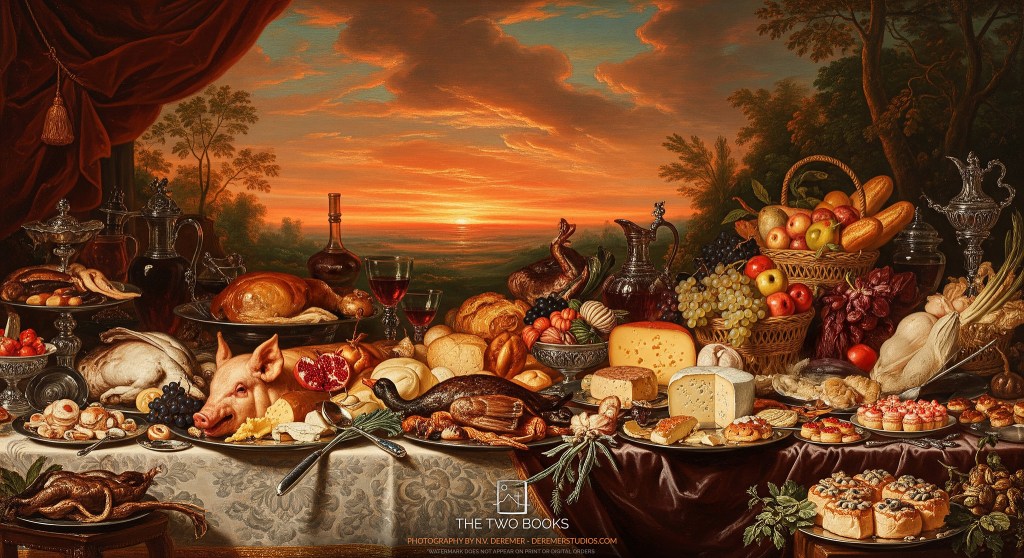
How a simple thought experiment reveals the transient nature of earthly satisfaction and points us to the need for a superior root of eternal joy.
You, 24 Hours, and 15,000 calories worth of a single ingredient. What could possibly go wrong?
While it may seem odd to be talking about eating a massive amount of calories just barely a month into the New Year, nevertheless, that’s exactly where we’re going to start today. There’s a thought experiment making the rounds that seems simple, even easy, at first blush. Here’s the scenario. You must eat 15,000 Calories in a 24 hour window and if you succeed, you’ll get $100,000. But there’s the catch – you can only eat one simple food – like a carrot, or a single type of beverage. Only one thing. Would you do it?
Impossible You Say?
As you start doing the math, as we did as a family gathered around the dinner table one night, you quickly begin to realize the question isn’t as much would you do it, but could you do it. It’s harder than it seems. If you tried to tackle it in a healthier way – after all it is the New Year – you’d have to eat 600 medium-sized carrots. That’s roughly 3,750 baby carrots if you’re counting. Either way, that’s about 85 lbs of carrot. No matter how much you like carrots, it seems like it would be all but biologically impossible to eat so much of a vegetable in 24 hours.
So, let’s consider, as we did, something a bit more calorically dense… ranch dressing. Who doesn’t love ranch dressing! In order to hit the 15,000 calorie target, you’d need to eat – or should I say, drink – 125 ounces of full fat dressing – or roughly 8 bottles of the stuff. I’ve got to imagine you’d be hating your life before you cleared even the first bottle.
Okay, so we thought, what about Coke? Imagine it’s a hot summer day – that’s got to be doable right? After all, there’s a lot of sugar in there. One two liter of Coke is 836 calories, meaning you’d still have to drink nearly 20 two-liters to get over the 15,000 mark – 40 liters of Coke. For reference, the maximum fluid a healthy set of kidneys can flush per day is 28 liters, so there’s a good chance that such an attempt could actually kill you.
But what if we cheated a little bit? Instead of a singular food item, what if we did something like a sub? One of our family traditions when we visit my folks in New England is to get Moe’s Italian Subs. I love them – so much so that when we were looking for a fundraiser for our church’s youth, I came up with the hair-brained idea of emulating these subs to sell on Super Bowl Sunday. Each sub is about 1,000 calories the way I like it. So, I’d have to eat 15 of them in 24 hours. But here’s the thing, by my second round of Moe’s subs on any given trip, I’m Moes’ed-out. They’re great, they’re really great, but I don’t think I could eat 15 of them, and even if I could, they’d probably be ruined for me for quite some time – maybe even forever. Gasp!
My point? Even the things we really love, when enjoyed in excess, become unenjoyable – even detestable. But why is that? Why is the first bite so much better than the last?
Fleeting Pleasures
“I have seen all the works which have been done under the sun, and behold, all is vanity and striving after wind.”
Ecclesiastes 1:14, NASB1995
Like chasing the 15,000 calorie challenge, we find with Solomon that all is vanity and striving after wind. And Solomon should know. He had it all. He had wealth, wisdom and women to the full. As king, he was incredibly powerful. There was seemingly no earthly pleasure that was beyond his ability to enjoy to the fullest. And yet, as an old man, having chased after satisfaction in all these ways, what we see in Ecclesiastes is not the picture of a joy-filled, contented, satisfied titan who has conquered the world, but a tableau of a sullen and sorrowful shadow of a man whose come to the end of all the world’s pleasures, and come up empty.
Like a train speeding away from a station, the more we chase satisfaction in the things of this world, the further away that satisfaction becomes. Cars, houses, accolades, conquests, fame – they all offer us the promise of satisfaction just over the horizon, but like an airliner streaking access the western sky, chasing the sunset, that sun is always going to be just over the pastel-colored horizon. And the funny thing is, not unlike that jet, the longer we chase after satisfaction in the things of this world, the dimmer and darker that horizon becomes. It’s a losing battle that ends in despair and destruction.
“No one can serve two masters; for either he will hate the one and love the other, or he will be devoted to one and despise the other. You cannot serve God and wealth.”
Matthew 5:24 NASB1995
The pleasures of this world, no matter how illicit or wholesome, simple or opulent, are not meant to be our masters. Our hearts are not built to find ultimate meaning and satisfaction in God’s gifts, whether pure or perverted, but in God Himself. As eternal creatures made in God’s image, we are made to find our greatest meaning and satisfaction not in creation, but in our Creator.
Perhaps that’s why the first half of that Moe’s Sub, or the first slice of pizza, or the first spoonful of ice cream is the most pleasurable. I was reminded of an illustration of this while listening to one of the Cross Con 2026 sessions. During the dark days of World War Two, CS Lewis wrote a rather obscure and curious trilogy of early science fiction. In the second book, Perelandra, the protagonist, Ransom finds himself on a new planet, full of sublime natural pleasures. Soon, he happens upon a balloon-like yellow gourd, which upon eating it, releases a wave of pure and indescribable pleasure and enjoyment. Naturally, he begins to take another, and that’s where we’ll pick up on CS Lewis’s story:
“As he let the empty gourd fall from his hand and was about to pluck a second one, it came into his head that he was now neither hungry nor thirsty. And yet to repeat a pleasure so intense and almost so spiritual seemed an obvious thing to do. His reason, or what we commonly take to be reason in our own world, was all in favour of tasting this miracle again; the child-like innocence of fruit, the labours he had undergone, the uncertainty of the future, all seemed to commend the action. Yet something seemed opposed to this “reason.” It is difficult to suppose that this opposition came from desire, for what desire would turn from so much deliciousness? But for whatever cause, it appeared to him better not to taste again. Perhaps the experience had been so complete that repetition would be a vulgarity—like asking to hear the same symphony twice in a day.”
As CS Lewis so perceptively observes, it is in our very nature to want that second piece – to feel the pleasure of joy and fleeting contentment that comes from such a pleasurable experience. Yet by God’s gracious design, such earthly pleasures inevitably come with diminishing returns – and taken to the extreme, turn what we once loved into a thing we despise.
Pleasures Forevermore
Every once in a great while, I’ll have this euphoric experience that feels just a little bit like what I imagine eternity will be like. Almost always, I’m driving on a back road, the sun is to my back in the late afternoon, I’m listening to worship music or sometimes a good sermon, and I’ve recently eaten – in that in-between stage where my hunger is satisfied, but the drowsiness of digestion has yet to set in. In those precious fleeting moments, all feels right in the world, I feel perfectly content and full of joy. And yet, even this sublime pleasure is so transient.
But there is one pleasure that will never slip away and never grow old – not even through the endless days of eternity. Perhaps, like me, you were once, or are now worried about being bored in Heaven. I remember as a teenager, feeling this concern often. I mean, chances are there aren’t going to be any video games or supercars or TVs or Legos or whatever else young me thought to be especially pleasurable. Sitting around in an endless worship service seemed as boring and mundane as my experience of Sunday mornings at my church. Of course, as I would come to discover, the main problem was not the worship service, and certainly not the worship we will experience in eternity, my problem was my own heart that found greater pleasure in the gifts of God than in God Himself.
What we see again and again is both a description and a command to find unending joy in the Lord. Consider just a few passages, below, and how they use the language of pleasure, enjoyment and satisfaction to describe our ultimate pleasure in God:
Psalm 16:11 – You will make known to me the path of life; In Your presence is fullness of joy; In Your right hand there are pleasures forever.
Psalm 19:10 – [Your Law is] more desirable than gold, yes, than much fine gold; Sweeter also than honey and the drippings of the honeycomb.
Psalm 34:8 – O taste and see that the Lord is good; How blessed is the man who takes refuge in Him!
Psalm 119:103 – How sweet are Your words to my taste! Yes, sweeter than honey to my mouth!
1 Peter 1:8 – And though you have not seen Him, you love Him, and though you do not see Him now, but believe in Him, you greatly rejoice with joy inexpressible and full of glory,
A Huger for Endlessly Satisfying Bread
“35 Jesus said to them, “I am the bread of life; he who comes to Me will not hunger, and he who believes in Me will never thirst. 36 But I said to you that you have seen Me, and yet do not believe. 37 All that the Father gives Me will come to Me, and the one who comes to Me I will certainly not cast out. 38 For I have come down from heaven, not to do My own will, but the will of Him who sent Me. 39 This is the will of Him who sent Me, that of all that He has given Me I lose nothing, but raise it up on the last day. 40 For this is the will of My Father, that everyone who beholds the Son and believes in Him will have eternal life, and I Myself will raise him up on the last day.”
John 6:35-40, NASB1995
In John 6, we get a glimpse into Jesus’ ministry to the crowds that were, as we soon discover, following Jesus in hopes of satiating their earthly hunger (26). Yet, Jesus is moved with compassion, and in love, points then to Himself and a sort of paradoxical hunger that is both fully satisfied and yet never fades. The sort of bread Jesus offers never grows stale. It is a bread that His people will always hunger for, even as they are ever satisfied by it. This is no common bread, but as Jesus makes clear in the passage above, it is Christ, Himself.
As we read on, we see that the crowd just isn’t getting it. What they are hungry for is a good meal, and so they press Jesus to prove Himself by giving them manna from Heaven, to which Jesus responds in the passage we see above. Jesus reiterates the amazing gift he is offering to this crowd – not some perishable bread, but a spiritual bread that will satisfy them beyond all measure. He goes further, asserting that the Father has given a people to the Son to redeem and raise up on the last day. He’s offering them Himself, that they may be ever satisfied, and yet, look at the response from the crowd, below:
“41 Therefore the Jews were grumbling about Him, because He said, “I am the bread that came down out of heaven.” 42 They were saying, “Is not this Jesus, the son of Joseph, whose father and mother we know? How does He now say, ‘I have come down out of heaven’?” 43 Jesus answered and said to them, “Do not grumble among yourselves. 44 No one can come to Me unless the Father who sent Me draws him; and I will raise him up on the last day. 45 It is written in the prophets, ‘And they shall all be taught of God.’ Everyone who has heard and learned from the Father, comes to Me. 46 Not that anyone has seen the Father, except the One who is from God; He has seen the Father. 47 Truly, truly, I say to you, he who believes has eternal life. 48 I am the bread of life. 49 Your fathers ate the manna in the wilderness, and they died. 50 This is the bread which comes down out of heaven, so that one may eat of it and not die. 51 I am the living bread that came down out of heaven; if anyone eats of this bread, he will live forever; and the bread also which I will give for the life of the world is My flesh.”
John 6:41-51, NASB1995
They didn’t believe Jesus. They were more than happy to see Him work miracles, but when it came to seeing Him as their Lord and Savior, they just weren’t interested. As Jesus continues to teach them about Himself and the mission of His Kingdom, the people continue to get hung up on Jesus words, and by verse 66, we read that many walked away from Jesus, both their bellies and their souls unsatisfied.
Yet, Jesus’ precious words in this chapter, if believed and embraced, are so sweet – so satisfying! What Jesus is offering us is a complete and unending satisfaction that transcends the trials and tribulations of this life, and as we see in Christ’s sovereign assurances in this passage, will bring us safely home to realms of endless glory filled with joy unspeakable and full of glory!
Jesus is our great satisfaction. Our Triune God is both the fount and focus of endless joy which we will experience in Eternity. Freed from the curse, free from all sin, free from every burden of this life, and with a perfectly crafted resurrection body to boot, not only will our capacity for joy be exponentially increased, but so will our enjoyment of its greatest object, God Himself. In such a setting, where we can finally see Jesus for who He is, in all His glory, and without the cloudy cataracts of sin that dim our perceptions in this life, we will see and savor His glory forevermore, with our even the slightest hint of boredom. We will at last be in the presence of Him for whom we were made!
May the Lord be pleased, by His grace, to grant us all to see and to savor God more and more in this life, that the things of earth might grow strangely dim in the light of His glory and grace…until we all obtain our glorious, eternal inheritance in Glory!
 The Two Books
Leave a comment